

Chiropractic Care in Clermont: What We Do, How It Works, and What to Expect
If you’re hurting after a car accident, or your back has been bothering you for weeks, you probably want a straight answer before you book anything: what does chiropractic care actually do, and is it right for what’s going on with you? Here’s the plain version. Chiropractic care is hands-on treatment focused on the spine and the muscles and joints around it, aimed at restoring normal movement and reducing pain. It doesn’t fix everything, and we’ll be honest with you about that. This page walks you through what we do, how a visit works, and what to expect, in English or Spanish.
Dr. JP Silvera runs Taylor-Made Health & Wellness in Clermont, treating auto-injury patients across Lake County and west Orange. We wrote this to answer the questions people actually ask before they come in.
This article is general information, not medical advice. Your situation should be evaluated in person.
What chiropractic care actually is
Chiropractic care is a hands-on approach to treating pain and movement problems in the spine and the joints, muscles, and nerves connected to it. According to the National Center for Complementary and Integrative Health, it’s most commonly used for back pain, neck pain, and headaches. The goal is to help joints move the way they’re supposed to.
A spinal adjustment is a controlled, targeted movement applied to a joint that has lost some of its normal range of motion. It’s precise, not forceful in the way people picture it.
The pop or crack you might hear worries a lot of first-timers. That sound is gas releasing from the fluid inside a joint, the same thing that happens when you crack a knuckle. It isn’t your bones or anything breaking.
Here’s where chiropractic fits next to other care. Physiotherapy leans on guided exercise and rehab. Pain management often involves medication or injections. Surgery addresses structural problems the other options can’t. Chiropractic works on joint movement and the soft tissue around it. It doesn’t replace any of those, and for some problems you’ll need one of them instead. We’re not shy about saying so.
Conditions we see most often, and ones we refer out
We treat a specific set of problems well, and we’re clear about the ones we don’t handle. The conditions we see most often are whiplash, neck pain, lower back pain, tension headaches, soft tissue injuries after a crash, and disc-related complaints where spinal decompression may help.
Some things fall outside what chiropractic can safely address. Fractures. Certain neurological conditions. Anything that looks like an acute surgical emergency. The American Chiropractic Association notes that a good chiropractic evaluation includes screening for exactly these red flags before any treatment starts.
So what happens if your case is one of those? We tell you. Then we point you to the right person, whether that’s an orthopedic surgeon, a neurologist, or the emergency room. We’d rather send you where you need to go than treat something we shouldn’t.
Naming the line openly is the whole point. A clinic that claims it can help with anything isn’t being honest with you. From our experience, being specific about what we treat is what earns trust in the first place.
What a first visit looks like, step by step
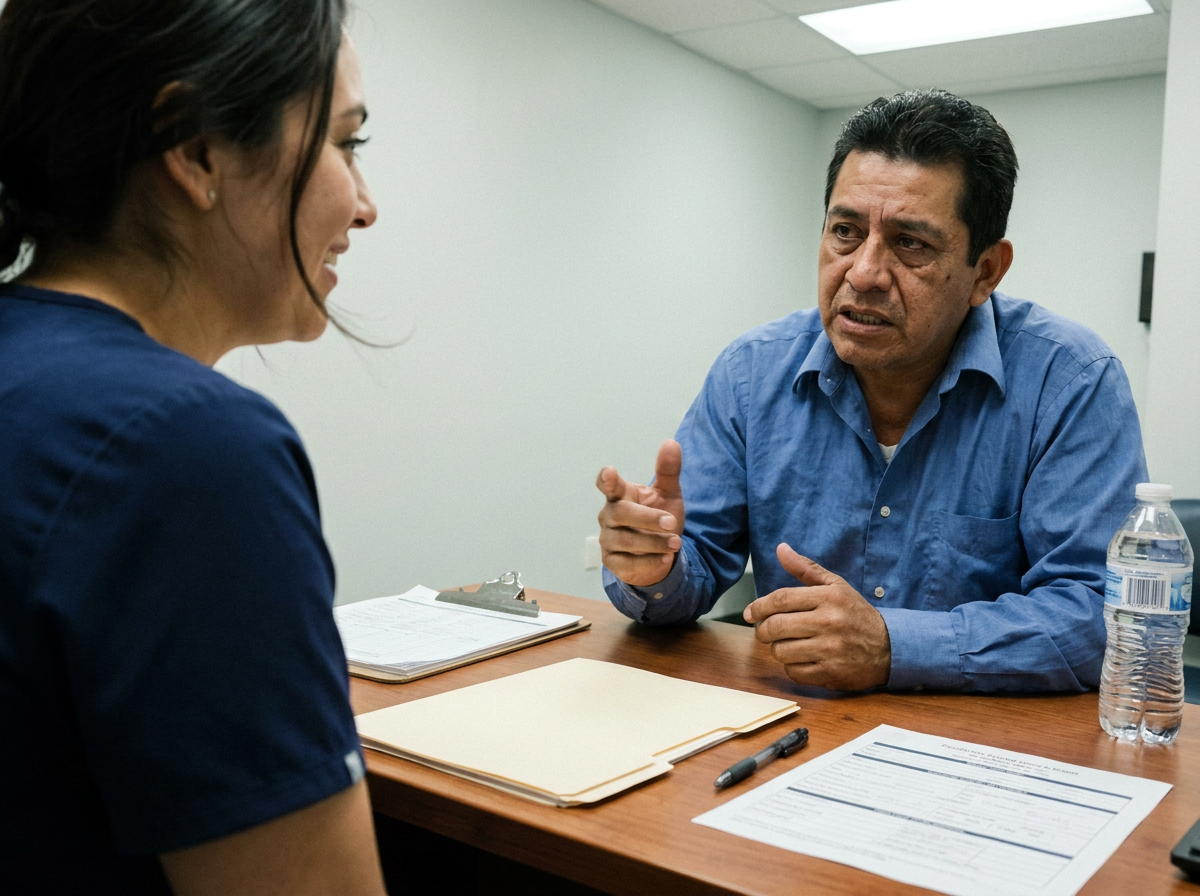
Your first visit starts with a conversation, not an adjustment. We want to understand what happened and where it hurts before anyone puts hands on you. If you were in an accident, we’ll ask about the crash, how you felt right after, and how you feel now.
After we talk, we do a physical exam. That means checking your range of motion, looking at your posture, and examining the areas you told us are bothering you. Plain movements, nothing surprising.
Imaging like X-rays gets ordered when the exam or your history points to a reason for it, for example if we’re concerned about something the hands-on exam can’t rule out. When it isn’t necessary, we don’t order it.
Nothing happens without you understanding it and agreeing to it first. If we recommend a treatment, we’ll explain why before we do anything.
One honest heads-up: first visits take longer than follow-ups. We’re building the full picture of what’s going on, and that’s not something to rush. Are there any other concerns you have? We’ll make room for them.
Spinal decompression: what it is and who it helps
Spinal decompression is a traction-based treatment that gently creates space between the vertebrae in your spine. That extra space reduces pressure on the discs and the nerves that run between them. It’s slow and controlled, not a sudden movement.
It’s typically used for disc problems: herniated discs, bulging discs, degenerative disc changes, and the radiating pain that can travel down a leg or an arm when a nerve is pinched. Research summarized by Harvard Health Publishing describes how pressure on a spinal nerve can cause that kind of radiating pain, which is the pattern decompression aims to ease.
What does a session feel like? You lie on a table, comfortable, and the device does the work. Most people find it relaxing. It isn’t painful.
Decompression isn’t right for everyone. Certain conditions make it a poor fit, and we assess that at your first visit before recommending it. We won’t put you on the table if it’s not the right call for your body. And we won’t frame it as a cure. It’s a tool that reduces pressure so your body has better conditions to heal.
Why people wait, and why that tends to make things harder
The most common thing we hear after a crash is “I feel fine.” Feeling fine right after an accident doesn’t mean nothing is wrong. That’s not a scare tactic, it’s just how the body works.
Soft tissue injuries like whiplash often take 24 to 72 hours to fully show up. The Mayo Clinic lists delayed neck stiffness, headaches, and reduced range of motion among whiplash symptoms that can surface days after the injury. Your body was flooded with adrenaline during the crash. That masks pain for a while.
Getting checked early means we catch things before they settle in. That’s the honest reason to come in, not fear.
If your crash happened in Florida, there’s also the PIP 14-day rule. Florida’s no-fault law requires you to seek medical care within 14 days of the accident for your Personal Injury Protection coverage to apply, per the Florida Department of Financial Services. We mention it because it’s a real deadline, not to rush you.
And this isn’t only about accidents. Everyday back and neck pain can quietly get worse when it’s left alone. Movement compensates around the sore spot, and the problem spreads. Getting it looked at sooner is usually easier than waiting.
How treatment is structured, and how long it takes
There’s no fixed number of visits that fits everyone, because no two injuries are identical. Anyone who promises you an exact count on day one is guessing. What we can describe is the general shape of care.
Early visits focus on calming acute pain and getting your range of motion back. Later visits shift toward stability and keeping the problem from coming back. That’s the arc most patients follow.
On frequency: a lot of plans start with a few visits a week and taper as you improve. That’s structured that way because soft tissue responds to consistent, repeated work early on, then needs less as it heals.
You have a role in this too. Moving when we ask you to, resting when you need it, and telling us honestly how you actually feel between visits. That last one matters more than people think.
Some conditions respond faster than others. We monitor your progress and adjust the plan as we go. If something isn’t working, we change it, and we’ll tell you why.
Insurance, paperwork, and billing in plain terms
We handle the PIP billing and the insurance paperwork so you don’t have to figure it out alone. That part is genuinely off your plate.
PIP, or Personal Injury Protection, is the coverage that pays for medical care after an auto accident in Florida, up to your policy limit, regardless of who caused the crash. According to the Florida Department of Highway Safety and Motor Vehicles, Florida drivers are required to carry a minimum of $10,000 in PIP coverage.
The “will I get a bill” question is a fair one. We bill your PIP insurance directly, and we’ll explain any balance before your care starts. We’ll walk you through your particular situation honestly, without pretending every scenario is the same.
For attorney-referred patients, Letter of Protection (LOP) arrangements are also available, which lets treatment proceed while a case is pending. We’ll explain how that works if it applies to you.
Care in English and Spanish, because it matters how you explain things
We serve patients in both English and Spanish. That means real bilingual care from people who speak the language, not a phone menu or a translated handout run through software.
Language matters more in a clinic than most places. You need to describe your pain accurately, in your own words. You need to ask questions freely and understand exactly what you’re agreeing to before it happens. Half of that gets lost when you’re straining to translate in your head while you’re already in pain and stressed.
For our Spanish-first patients, WhatsApp is the easiest way to reach us. You can message us, tell us what’s going on, and get a real answer from a real person before you ever come in.
Estamos aquí para ayudarle. We mean it in both languages.

Key takeaways
- Chiropractic care is hands-on treatment for the spine and surrounding joints, muscles, and nerves, aimed at restoring movement and reducing pain.
- We treat whiplash, neck and back pain, tension headaches, and disc problems, and we refer out fractures, neurological conditions, and surgical emergencies.
- Your first visit starts with a conversation and an exam. Nothing happens without your understanding and agreement.
- After a crash you can feel fine and still be injured; whiplash symptoms often surface 24 to 72 hours later.
- Florida’s PIP rule requires medical care within 14 days of an accident for that coverage to apply.
- We handle PIP billing and paperwork, and we offer care in English and Spanish, with WhatsApp for Spanish-first patients.
Frequently asked questions
Does a chiropractic adjustment hurt?
Most adjustments aren’t painful. You may feel pressure and hear a pop, which is gas releasing from the joint, the same as cracking a knuckle. Some patients feel mild soreness afterward, similar to after exercise, which usually settles within a day or two.
How soon after a car accident should I see a chiropractor?
Sooner is better, ideally within a few days. Whiplash and soft tissue injuries can take 24 to 72 hours to fully show up. In Florida, you generally need to seek care within 14 days of the accident for PIP coverage to apply, so getting checked early protects both your health and your options.
How many chiropractic visits will I need?
It depends on your injury, and no honest provider can give you an exact number upfront. Many plans start with a few visits a week and taper as you improve. Early visits target pain and range of motion; later ones focus on stability. We monitor your progress and adjust as we go.
Will I get a bill for chiropractic care after an accident?
We bill your PIP insurance directly, and we’ll explain any balance before your care starts. The specifics depend on your policy and your case. We handle the billing and paperwork and will walk you through your exact situation before you commit to anything.
Do you offer care in Spanish?
Yes. We provide real bilingual care in English and Spanish, not translated scripts. Spanish-first patients can reach us by WhatsApp to ask questions and describe what’s going on before booking.
Before you book anything
Come in, tell us what’s going on, and we’ll walk you through what we find and what we think can help. We’ll